utorak, 9. srpnja 2019.

Renewable Energy Ukraine


Ukraine is carrying out reforms in an attempt to become more closely aligned with the European Union – but developing the country is almost impossible without sustainable economic growth and investments. Recent and upcoming changes will make Ukraine more attractive for investing.
Aссording to the data provided by the Ukraine's energy regulator, the National Energy and Utilities Regulatory Commission (NEURC), as of January 1, 2018, the cumulative installed capacity of renewables under the FIT (without those plants located in the territory of the Autonomous Republic of Crimea) totaled 1,374.7 MW, of which solar power plants accounted for ca. 55% (741.9 MW), and wind power plants, ca. 33.8% (465.1 MW).
In 2017 alone, 257 MW of the installed capacity of renewables under the FIT were operational, which is more than double the capacity put into operation in 2016 (ca. 127 MW), and eight times the capacity in 2015 (ca. 30 MW). The solar power plants put into operation in 2017 accounted for ca. 82% of the cumulative capacity of renewables under the FIT, while wind power plants accounted for ca. 10.6% of such cumulative capacity.


Year by year, the country is improving its position in the World Banks’ Doing Business ranking. Ukraine’s capital Kiev is on the top ten list of the cost-effective locations published by fDi Intelligence Magazine. So, investing in Ukraine’s economy is becoming increasingly appealing. Energy is among the most attractive options to invest in Ukraine. Until now, the only type of energy that saw foreign investments in Ukraine was renewable energy. Relatively high feed-in tariffs, calculated in euros and correspondingly protected from the risk deflation was the main reason for this. Other types of energy were not interesting for investors because of the absence of a developed energy market and because of strict government control and regulation. For instance, the government and the energy-regulating commission defined gas and electricity prices for final consumers. Obviously, energy prices, together with transparency and the predictability of the energy market’s environment define how profitable energy assets are, which include generating capacities and transmission lines. Correspondingly, all these determine investors’ interest. And these prices were not enough in Ukraine to justify investments towards upgrading the deteriorating energy infrastructure. Since Ukraine became independent, almost no new power plants were constructed, except for renewables. Given the absence of market pricing and the strength of government regulations, there is always a risk that that energy prices for the consumer will decrease to a level that will seriously affect how profitable investments are.
Since energy reforms started in Ukraine, after the 2014 revolution, some populist politicians have called to change electricity and gas pricing approaches in order to reduce prices. Clearly, this has not contributed to investors’ interest  No one wants to invest, knowing that some governmental body may change the pricing method and affect the profitability of investment. Hence, it is not surprising that no foreign investors have attempted to buy energy enterprises over the past few years. However, Ukraine’s energy sector is about to become significantly more attractive. On July 1, a new electricity market model will come in force. Two years ago, the Ukrainian parliament adopted the law that stipulated a new electricity market model similar to the one EU member states employ. It will finally enable integrating the Ukrainian power grid to the ENTSO-E.


There is still a debate if the country made all the necessary preparations to launch this new electricity market. But most experts, market actors and officials agree that it is more than possible to launch the market on time.Electricity market reform will help boost investment in the sector. According to an assessment by the Ukrainian Institute for the Future (UIF), published in a report on the outcomes of the electricity market reform, electricity-generating companies will be able to attract 11,5 times more investment compared to a no-reform scenario. There will be similar effects on electricity-distributing companies. On average, the reform will create demand for $3.66 billion of investments annually in electricity generation and distribution. The reform will give a boost to Ukraine’s economy more generally.


Change of the structure of the total final energy consumption and impact of energy efficiency according to the revolutionary scenario.
The gas market is another good opportunity for investment. According to BP Review, Ukraine holds the second-largest gas reserves in Europe.  And recent legislative changes to the start of the auctioning process for exploration and extraction have liberalised gas production regulation and will make the process more transparent. The gas market law was adopted in 2015. But there is still no fully liberalised gas market in Ukraine because of public service obligations (PSO) to provide affordable energy to households. These PSOs restrict the number of companies involved in selling gas to households. The PSOs will be eliminated after 2020. But that is not a restriction for investing in gas extraction in Ukraine. Importantly, investing in Ukraine’s energy is not only about Ukraine’s internal market, but also about huge opportunities for exports. Being close to the European Union opens opportunities to export energy to EU member states. These are deeply energy-dependent, in need of more energy and a more diverse energy supply. Conducting energy reforms and investments will boost Ukrainian energy exports to the EU. Estimates show the reform will result in boosting electricity exports to 25 billion kWh in 2030, compared to current 5 billion kWh. In the case of natural gas, developing of Ukraine’s gas production and trading may become a part of a geopolitical gamble. Several pieces of US legislation are aimed at protecting Ukrainian energy security. US support in the development of Ukraine’s energy exports will result in deepening interdependency with neighboring states and will contribute to regional stability. Finishing energy reforms with political and economic support from its main allies, primarily the USA, will strengthen Ukraine’s economics and boost energy exports. 
In Ukraine, there are already proposals to consider new approaches to selling electricity produced from RES, such as power sale auctions, which are increasingly coming into focus, or feed-in premiums. It can be foreseen that incentives for power production from RES will become more diversified in Ukraine in the years to come, and will not be solely limited to a FIT.


Expected greenhouse gas emissions in Ukraine under revolutionary scenario

The general consensus is that auctions or other novel structures – notwithstanding their being progressive, and matching objective global trends in the development of the renewable energy industry, or corresponding to technology maturity and cost – should be introduced gradually, so as not to undermine the stability, consistency and continuity of the regulatory framework in the country, and prevent any adverse effects on ongoing projects.

utorak, 25. lipnja 2019.

Waves to Water Prize


U.S. Department of Energy (DOE) officially opened the first stage of the Waves to Water Prize, which seeks to accelerate the development of wave energy powered desalination systems and launch novel technologies to address critical water security challenges. The prize is divided into four stages, and the first concept stage is now open for applications through September 11, 2019.  
“The start of the Waves to Water Prize marks an important step toward driving growth and progress in the marine energy sector as well as spurring innovation to develop desalinization technologies that will have a global impact,” said U.S. Under Secretary of Energy Mark W. Menezes. “Supplying potable drinking water is a significant challenge in many parts of the world, and we have the opportunity to use the power of competition to find lasting solutions through the development of these two industries.”
The Waves to Water prize will offer competitors up to $2.5 million in prizes for winners to advance their solutions from concept, to technical design, to the building of a prototype, and culminate in an open water testing competition, where the systems will produce clean water using only waves as power sources. The initial concept stage has $200,000 in prizes, with up to $10,000 in funding for up to 20 winners. DOE is seeking interdisciplinary solutions that are modular and easily transportable, and ultimately can serve the clean water needs of remote communities or aid in disaster relief scenarios. More information on specific guidelines for submissions and rules of the competition can be found here.
The prize is the first to be launched by DOE under the White House-initiated Water Security Grand Challenge – a DOE-led framework to advance transformational technology and innovation to meet the global need for safe, secure, and affordable water.
The Waves to Water Prize is led by the EERE Water Power Technologies Office and administered by the National Renewable Energy Laboratory on the American Made Challenges platform. This prize builds on the success of DOE’s Wave Energy Prize, which catalyzed the development of technologies that doubled the energy captured from ocean waves.
The Water Security Grand Challenge is a White House initiated, U.S. Department of Energy led framework to advance transformational technology and innovation to meet the global need for safe, secure, and affordable water. Using a coordinated suite of prizes, competitions, early-stage research and development, and other programs, the Grand Challenge has set the following goals for the United States to reach by 2030:
Goal 1: Launch desalinaton technologies that deliver cost-competitive clean water
BACKGROUND – Over the next 10 years, 40 states expect water shortages in some areas. Cost-competitive desalination technologies can address water security and alleviate water stress by expanding alternative water resources, such as seawater, estuaries, brackish groundwater, and other sources.
CHALLENGE – Current technologies are energy intensive, with energy costs up to 10 times that of treating freshwater. Environmental issues, such as brine disposal, also pose a challenge.
OBJECTIVE – The Water Security Grand Challenge aims to address these barriers by accelerating research, development and deployment to decrease the cost of processed water, increase water supply resilience, and increase the access to low-cost water.  
Current and Recent Opportunities:
An illustration of a wave of water filling a glass with ocean waves in the background.
US Department of Energy
Goal 2: Transform the energy sector’s produced water from a waste to a resource
BACKGROUND – Produced water is a byproduct of oil and natural gas extraction, uranium mining, and carbon capture, utilization, and storage. In 2012, an estimated 21.2 billion barrels of produced water from oil and gas were generated in the United States.
CHALLENGE – The high cost of removing constituents specific to produced water can make it cheaper to dispose produced water than treat it. Even so, current disposal practices in oil and gas cost about $40 billion annually.
OBJECTIVE – The Water Security Grand Challenge aims to accelerate research, development and deployment of cost-effective treatment of produced water that can address water scarcity in water-stressed regions by creating alternative water sources for agricultural use, mineral extraction and processing, and other industrial operations, while creating new revenue for the extraction industry through water sales. 
Current and Recent Opportunities:
Fracking equipment in a field at daytime.
Goal 3: Achieve near-zero water impact for new thermoelectric power plants, and significantly lower freshwater use intensity within the existing fleet
BACKGROUND – Thermoelectric power plants utilize large volumes of freshwater for cooling operations. This water use accounts for about 40% of water withdrawals in the United States. Effluent water from thermoelectric power plants that is returned to its source can affect aquatic ecosystems if altering natural water temperatures and flows. Water that evaporates and is not returned to its source is considered consumed; this accounts for about 3% of U.S. water consumption.
CHALLENGE – The thermoelectric power sector’s reliance on water poses a risk in light of anticipated warming ambient temperatures, increased water stress, and more frequent extreme events like droughts. If improperly managed, the water demand of the thermoelectric power sector may limit water available to other uses, limiting economic growth of surrounding communities.
OBJECTIVE – The Water Security Grand Challenge aims to accelerate research, development and deployment of new technologies that lead to near-zero water impacts for newly built thermoelectric power plants along with significantly lower freshwater use intensity for existing thermoelectric power plants. 
Current and Recent Opportunities:
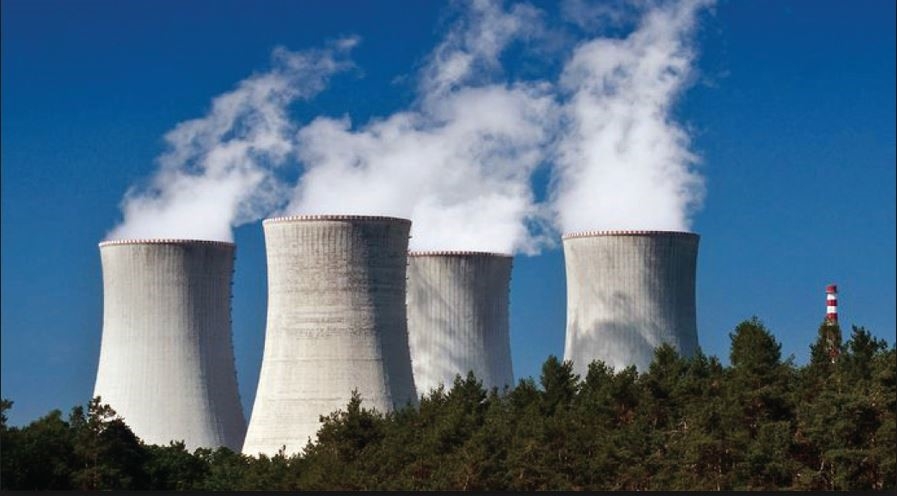
Steam emerges from three powerplant stacks.
Goal 4: Double resource recovery from municipal wastewater
BACKGROUND – Wastewater treatment plants purchase about $2 billion of electricity each year and face more than $200 billion in future capital investment needs to meet water quality objectives. This can constrain municipal budgets. For example, energy consumption at wastewater treatment plants can account for a third or more of municipal energy bills. Wastewater treatment plants can address these challenges by recovering critical resources and turning them into marketable products. This can create new revenue streams for upgrading water treatment infrastructure, particularly in rural communities, prevent nutrient pollution, and provide new sources of alternative water supplies. Recovered resources include energy that can be used on-site or sold, nutrients, such as phosphorous and nitrogen that can be used as fertilizer, and clean water that can be reused for agricultural, industrial, and potable purposes.
CHALLENGE – Energy costs are expected to increase over time and affect affordability of water for businesses and consumers. Disposal of residual biosolids from water treatment is another significant cost for municipalities.
OBJECTIVE – The Water Security Grand Challenge aims to pursue research, development, deployment and other opportunities to increase resource recovery. 
Current and Recent Opportunities:
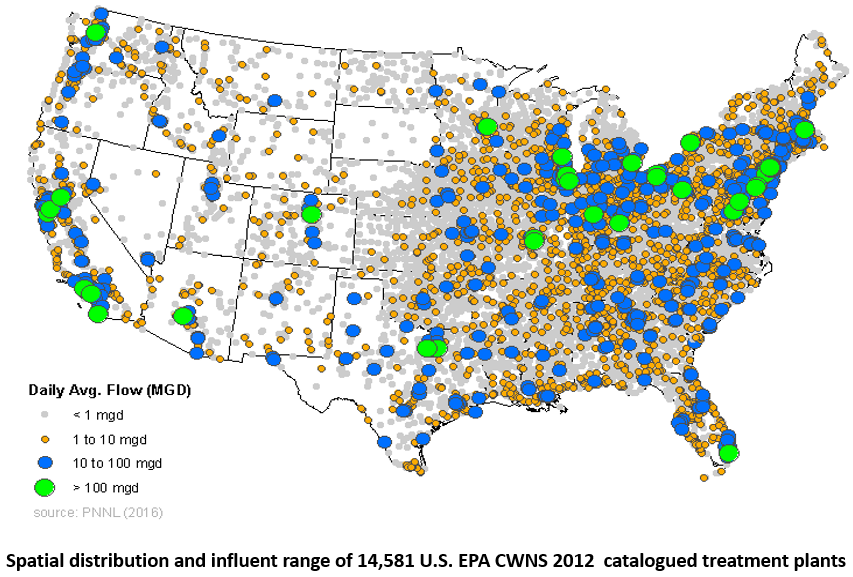
U.S. map showing dots that indicate spatial and influent ranges of catalogued treatment plants.
Goal 5: Develop small, modular energy-water systems for urban, rural, tribal, national security, and disaster response settings
BACKGROUND – Small, modular energy and water systems have the potential to cost-effectively serve areas where energy and clean water are expensive and challenging to produce. Small, decentralized energy-water systems can also play an important role in serving the more than one billion people worldwide that currently lack access to reliable sources of electricity and water.
CHALLENGE – The ability to cost-effectively produce clean water for urban settings where population growth is occurring but central energy or water systems are nearing maximum capacity; for rural communities, including tribal regions where population levels cannot accommodate the economies of scale needed to make large systems viable; for military sites in remote areas without access to central electricity and water systems; and in areas impacted by disaster when storms and other events have knocked existing energy and water systems offline.
OBJECTIVE – The Water Security Grand Challenge aims to spur innovation needed to improve the cost-effectiveness of small, modular linked energy-water systems and test their performance for a range of applications.
Current and Recent Opportunities:

ponedjeljak, 3. lipnja 2019.

Clean energy for all


Clean energy for all Europeans package completed: good for consumers, good for growth and jobs, and good for the planet


The Council of ministers of the EU formally adopted four new pieces of EU legislation that redesign the EU electricity market to make it fit for the future. This concludes the remaining elements of the Clean energy for all Europeans package and represents a major step towards completing the Energy Union, delivering on the priorities of the Juncker Commission.
The gradual transition towards clean energy and a carbon-neutral economy is one of the greatest challenges of our time. The EU, in 2016, decided to tackle it by rewriting the EU’s energy policy framework to facilitate this clean and fair energy transition. By providing a modern, stable legal environment and setting a clear and common sense of direction, the EU can stimulate the necessary public and private investment and bring European added value by addressing these challenges together. As a package, the new rules will reinforce consumer rights, putting them at the heart of the energy transition; they will create growth and green jobs in a modern economy leaving no region and no citizen behind. They will enable the EU to show leadership in the fight against climate change following the Paris Agreement.
Commissioner for Climate Action and Energy Miguel Arias Cañete said:

This is the most ambitious set of energy proposals ever presented by the European Commission. It has been adopted in record time with impressive support from the European Parliament and Council. With its completion, we have made the EU's Energy Union - one of the ten political priorities of the Juncker Commission – a reality. I truly believe it will accelerate the clean energy transition and give all Europeans access to secure, competitive and sustainable energy.
The Clean energy for all Europeans package sets the right balance between making decisions at EU, national, and local level. Member States will continue to choose their own energy mix, but must meet new commitments to improve energy efficiency and the take-up of renewables in that mix by 2030. For example, the new rules on the electricity market, which have been adopted today, will make it easier for renewable energy to be integrated into the grid, encourage more inter-connections and cross-border trade, and ensure that the market provides reliable signals for future investment. Today’s rules also require Member State to draft plans to prevent, prepare for and manage possible crisis situations in the supply of electricity in coordination with neighbouring Member States, and to enhance the role of the Agency for the Cooperation of Energy Regulators (ACER).
Background
The EU was an early mover on clean energy: it was the first major power in the world to set, in 2009, ambitious energy and climate targets for 2020 (20% greenhouse gas emission reduction, 20% in renewable energy and 20% energy efficiency). Ten years later, the EU is broadly on track to achieve theses 2020 objectives, proving it is possible to reduce emissions and achieve GDP growth at the same time. In the meantime, renewable energy has become much cheaper. Moreover, with the 2015 Paris Climate Agreement, the EU pledged to move further ahead and achieve greenhouse gas emission reductions of at least 40% by 2030. In order to respond to this challenge and continue to lead the global energy transition, the Commission proposed in 2016 a set of ambitious new rules called the “Clean Energy Package for all Europeans”. With this package the Commission addressed all 5 dimensions of the Energy Union (1) energy security; 2) the internal energy market; 3) energy efficiency; 4) decarbonisation of the economy; and 5) research, innovation and competitiveness.). It is composed primarily of the following elements:
  1. Energy efficiency first: the revamped directive on energy efficiency sets a new, higher target of energy use for 2030 of 32.5%, and the new Energy performance of buildings directive maximizes the energy saving potential of smarter and greener buildings.
  2. More renewables: an ambitious new target of at least 32% in renewable energy by 2030 has been fixed, with specific provisions to foster public and private investment, in order for the EU to maintain its global leadership on renewables.
  3. A better governance of the Energy Union: A new energy rulebook under which each Member State drafts National Energy and Climate Plans (NECPs) for 2021-2030 setting out how to achieve their energy union targets, and in particular the 2030 targets on energy efficiency and renewable energy. These draft NECPs are currently being analysed by the Commission, with country-specific recommendations to be issued before the end of June.
  4. More rights for consumers: the new rules make it easier for individuals to produce, store or sell their own energy, and strengthen consumer rights with more transparency on bills, and greater choice flexibility.
  5. A smarter and more efficient electricity market: the new laws will increase security of supply by helping integrate renewables into the grid and manage risks, and by improving cross-border cooperation.
In addition to the legislative acts of the package, the Commission also proposed a number of non-legislative initiatives, in particular to ensure a fair and just transition where nobody and no region is left behind:
Related links:

četvrtak, 2. svibnja 2019.

Renewable energy today

Renewable energy today


Renewable Energy Now.

Environmental awareness is increasing, and according to a study carried out in late 2018, 73% of the United States thinks climate change is happening, while 62% of the country believes it is human caused. Electricity production across the world is undergoing change, and more investment is being made in innovation, manufacturing, and applications for clean-energy solutions.

According to the U.S. Energy Information Administration, electricity generation in the United States in 2018 was 63.5% from fossil fuels, 19.3% from nuclear energy, and 17.1% from renewable energy sources. Among renewable energy, the main sources were 7% hydropower, 6.6% wind, and 1.6% solar power. Of fossil fuels, natural gas was at a record high of 35%, while coal saw an all-time post-WW2 record low of 27% in 2018.

The United States is currently one of the top three countries in the world in wind turbine production. There were one million solar installations in the United States in 2016, and this is expected to rise to two million in early 2019 and to four million solar installations by 2023. Both technologies are projected to grow and become more prevalent in U.S. electricity generation in the near future. The U.S. Department of Energy foresees a 10% increase in generation by solar power and a 12% increase in generation by wind power in 2019.  


There are three trends likely to impact the growth of renewable energy in the United States in 2019:

Emerging federal, state, and local political support: New local, state, and federal initiatives are receiving more attention and support. For instance, Hawaii and California have set the goal of 100% renewable energy by 2045, while over 200 mayors in the United States have established the objective of 100% renewable by 2035. New policies are expected to trigger further growth in wind and solar power.
Increase in investment: By the end of 2018, 156 global corporations — many based in the United States — have committed themselves to 100% renewable energy. Corporate procurement continues to increase, and asset management companies are collecting renewable energy portfolios. One example is Goldman Sachs, which has acquired 76 solar energy projects found on 143 sites. Investment in renewable energy in the United States exceeded $40 billion in both 2017 and 2018, and total private investment in renewable energy could reach a cumulative $1 trillion between 2018 and 2030.
Investment in technology is also on the rise, with advancements in technology bringing costs down. Research on solar and wind power are areas of interest, with more research via government investment on the horizon. The U.S. Office of Energy Efficiency and Renewable Energy budget was increased by 2% for 2019 to reach $2.38 billion by Congress.

Emerging policies, advancements in technology, increases in investment, and more social awareness will most likely cause an increase in renewable energy growth in 2019 in the United States. The decrease in renewable energy costs, in addition to favorable federal policies, are also likely to stimulate renewable demand.


In G20 countries, energy generation by fossil fuels costs between $0.05 and $0.17 per kilowatt-hour today. Renewable energy is expected to cost $0.03-$0.10 per kilowatt-hour by 2020, while the price of onshore wind power and solar photovoltaic projects could be as low as $0.03 per kilowatt-hour by 2019.

Renewable energy demand will expand opportunities; and although there is some political resistance, the general trend in the United States and worldwide is towards sustainability and renewable energy growth.

The decade-long trend of strong growth in renewable energy capacity continued in 2018 with global additions of 171 gigawatts (GW), according to new data released by the International Renewable Energy Agency (IRENA) today. The annual increase of 7.9 per cent was bolstered by new additions from solar and wind energy, which accounted for 84 per cent of the growth. A third of global power capacity is now based on renewable energy.  

IRENA’s annual Renewable Capacity Statistics 2019, the most comprehensive, up-to-date and accessible figures on renewable energy capacity indicates  growth in all regions of the world, although at varying speeds. While Asia accounted for 61 per cent of total new renewable energy installations and grew installed renewables capacity by 11.4 per cent, growth was fastest in Oceania that witnessed a 17.7 per cent rise in 2018. Africa’s 8.4 per cent growth put it in third place just behind Asia. Nearly two-thirds of all new power generation capacity added in 2018 was from renewables, led by emerging and developing economies.


“Through its compelling business case, renewable energy has established itself as the technology of choice for new power generation capacity,” said IRENA Director-General Adnan Z. Amin. “The strong growth in 2018 continues the remarkable trend of the last five years, which reflects an ongoing shift towards renewable power as the driver of global energy transformation.

“Renewable energy deployment needs to grow even faster, however, to ensure that we can achieve the global climate objectives and Sustainable Development Goals,” continued Mr. Amin. “Countries taking full advantage of their renewables potential will benefit from a host of socioeconomic benefits in addition to decarbonising their economies.”  

IRENA’s analysis also compared the growth in generation capacity of renewables versus non-renewable energy, mainly fossil-fuels and nuclear. While non-renewable generation capacity has decreased in Europe, North America and Oceania by about 85 GW since 2010, it has increased in both Asia and the Middle East over the same period. Since 2000, non-renewable generation capacity has expanded by about 115 GW per year (on average), with no discernible trend upwards or downwards.


Hydropower: Growth in hydro continued to slow in 2018, with only China adding a significant amount of new capacity in 2018 (+8.5 GW).

Wind energy: Global wind energy capacity increased by 49 GW in 2018. China and the USA continued to account for the greatest share of wind energy expansion, with increases of 20 GW and 7 GW respectively. Other countries expanding by more than 1 GW were: Brazil; France; Germany; India; and the UK.

Bioenergy: Three countries accounted for over half of the relatively low level of bioenergy capacity expansion in 2018. China increased capacity by 2 GW and India by 700 MW. Capacity also increased in the UK by 900 MW.

Solar energy: Solar energy capacity increased by 94 GW last year (+ 24 per cent). Asia continued to dominate global growth with a 64 GW increase (about 70% of the global expansion in 2018). Maintaining the trend from last year, China, India, Japan and Republic of Korea accounted for most of this. Other major increases were in the USA (+8.4 GW), Australia (+3.8 GW) and Germany (+3.6 GW). Other countries with significant expansions in 2018 included: Brazil; Egypt; Pakistan; Mexico, Turkey and the Netherlands.

Geothermal energy: Geothermal energy increased by 539 MW in 2018, with most of the expansion taking place in Turkey (+219 MW) and Indonesia (+137 MW), followed by the USA, Mexico and New Zealand.


Globally, total renewable energy generation capacity reached 2,351 GW at the end of last year – around a third of total installed electricity capacity. Hydropower accounts for the largest share with an installed capacity of 1 172 GW – around half of the total. Wind and solar energy account for most of the remainder with capacities of 564 GW and 480 GW respectively. Other renewables included 121 GW of bioenergy, 13 GW of geothermal energy and 500 MW of marine energy (tide, wave and ocean energy).


Croatian Center of Renewable Energy Sources (CCRES)

ponedjeljak, 4. rujna 2017.

Take control of your energy consumption


Take control of your energy consumption

The Powerwall is a home battery system that turns your home’s solar panels into an all day resource – increasing self-consumption of solar – while also offering backup in the event of an outage. The Powerwall enables more of your home’s electricity use to come from solar, which enhances solar functionality, and reduces energy costs.
When solar panels produce more power than a home needs, the excess solar is sent back to the grid. The Powerwall enables a homeowner instead to capture and store excess solar power produced during the day for use at night. The result is greater self-consumption of your solar generation and reduced energy costs.

Tesla is far from the only company looking to profit off of rechargeable batteries for the home.

At-home batteries are a necessary purchase for anyone looking to convert their home to solar power. The batteries store the electricity generated by solar panels, which can then be used at night or during peak grid times to save money on your electricity bill.

But the batteries can also be used to charge electric vehicles, which is why many automakers are now selling their own units.

Scroll down to see the 10 at-home batteries looking to take on Tesla's Powerwall 2:

First, some information on Tesla's Powerwall 2 — a 264-pound, lithium-ion battery that you can mount on your wall. Panasonic makes the cells for the battery, while Tesla builds the battery module and pack.

A single Powerwall unit stores 14 kWh of energy, but you can link up to 10 batteries side-by-side to increase storage. A single unit, including installation, can cost as much as $11,450.

POWERWALL 2 SPECIFICATIONS

Technology
Wall mounted, rechargeable lithium ion battery with liquid thermal control.

Model 2
13.2 kWh – For daily cycle applications

Warranty
10 years

Supported Applications
Solar self-consumption, Time of use load shifting, BackUp

Power
7kW peak / 5kW continuous

Scalable
Up to 9 Powerwalls

Dimensions
1150mm x 755mm x 155mm

Installation
Floor or wall mounted
Indoor or outdoor

Operating Temperature
-20°C to 50°C

Use more of your solar
Instead of sending excess solar energy into the grid, Powerwall stores it for use any time.

Weight
110kg

Always connected
Monitor your solar energy use in real-time and receive alerts when Powerwall is preparing for cloudy or severe weather.

All in one inverter
Powerwall uses an internal inverter to convert DC energy to the AC energy required for your home, lowering cost and complexity.

Depth of Discharge
100%

Tesla has offered battery and solar installations as one process ever since it acquired SolarCity last November. Tesla is now selling solar roof shingles that are designed to look like an actual roof to compete with rival solar installers, like Sunrun and Vivint, on an aesthetic level.

1. LG Chem's RESU battery is probably Tesla's closest competitor in the space. Last October, LG Chem partnered with solar company Sunrun to bring its battery option to the US.

The RESU is now available to Sunrun customers and its products distribution arm — a similar strategy to making the Powerwall available to SolarCity customers. It stores up to 9.8 kWh of energy and starts at around $4,000 for lower-voltage options.

2. Mercedes also has the potential to rival Tesla's home battery business. The company announced Thursday it will partner with Vivint to sell its home battery in California.

The German automaker is following Tesla and LG Chem by partnering with a solar company to combine the battery and solar installation processes. Mercedes' battery stores 2.5 kWh of energy, but units can be combined to store 20 kWh. The biggest storage option costs $13,000, installation included.

3. Nissan offers a rechargeable battery option, called XStorage, which holds 4.2 kWh of energy storage. The automaker began selling the XStorage in May in the United Kingdom, where Tesla and Mercedes also sell their battery options.

Nissan's xStorage battery costs $4,500, which includes the price of installation. Nissan is looking to set itself apart as a sustainable battery provider by using old battery cells in the units.

4. BMW plans to sell two battery options that can store a whopping 22 kWh and 33 kWh worth of energy, but they have yet to launch. Like Nissan, BMW will take a sustainable approach by reusing batteries from its BMW i3 series.

5. Sonnen, a German company, sells several at-home battery options with up to 16 kWh of storage. The eco compact version pictured here holds 4 kWh of energy and costs $5,950. It comes with the inverter included.

The company derives two-thirds of its revenue from its German operations, but is looking to expand abroad. Sonnen opened a factory in Atlanta in April to begin production for the US market. It also has plans to expand to Australia, the United Kingdom, and Italy.

6. SimpliPhi Power is an at-home battery maker that's been around since 2002, but its original name was LibertyPak Company. SimpliPhi offers several battery options, the largest of which stores 3.4 kWh of energy.

SimpliPhi's batteries can be combined to make a battery pack as large as you need. The company recently partnered with solar installer CivicSolar to provide a comprehensive energy system.

7. Sunverge offers battery systems providing anywhere from 7.7 kWh to 19.4 kWh of energy storage. Weighing around 500 pounds, the battery has to be installed by a trained Sunverge specialist.

Sunverge comes with a corresponding app so you can monitor your solar energy storage and see electric grid costs at different times. A Sunverge unit can cost between $8,000 and $20,000, depending on the size you get.

8. Powervault is an at-home battery system that is sold in the UK. All units come with an inverter included, and the most powerful model stores 6 kWh of energy. Prices start at roughly $3,000.

9. Palo Alto-based ElectrIQ sells a battery for US homes that stores 10 kWh of energy. Its retail price is about $16,000 and includes the price of an inverter.

10. Panasonic, which makes the cells for Tesla's home battery, also has its own unit that can store 8 kWh of energy. It's currently available in Australia.

Panasonic's battery weighs about 185 pounds, but the cost of a unit is not made readily available.